Wednesday, October 14, 2009

2009 Canadian National Cyclocross Championships

So, Ed and I decided we should try again to watch 'cross nationals - though there were 2 major differences this year compared to last year: 1) weather - below freezing temperatures with snow, and 2) our 4 month old daughter with whom we'd had no prior experience yet out in the snow and cold. Chloe got a brand-new snowsuit the day before and we were set to go. Except that it took more time than expected to actually get her into the snowsuit and then be able to properly tighten up her carseat, so we missed the start of the womens' and juniors' race (we knew it would be too long a day for Chloe if we'd even tried to watch the U23 race).

First thing we noticed when we arrived was that the course had changed a bit from last year, and even included a sandpit - through the playground! I thought perhaps this was the Canadian way (ie. low-cost when cyclocross isn't exactly the #1 sporting event around) but found out later that there's actually a new UCI rule preventing "artificial" sandpits from being incorporated into cyclocross courses.

So, after watching a few laps at the sandpit, we headed for the finish line in time to see Kris Dahl (Team Alberta) win the Junior mens' race, and Alison Sydor (Rocky Mountain-Maxxis) win the womens'. Sydor, at age 42, is apparently the first Canadian to have won national titles in the 3 disciplines of MTB, road and cyclo-cross (though Christian Meier had previously won in 3 different disciplines: road, track and cyclo-cross).
Finish line (not many people there during the actual race as there were more exciting spots to watch - but definitely far fewer this year due to the weather)

Canadian Junior mens' champ Kris Dahl

Canadian Womens' champ Alison Sydor

Junior Mens' podium

Womens' podium - Pepper Harlton (2nd), Alison Sydor (1st), Natasha Elliott (3rd)
(note that defending womens' champ Wendy Simms did not compete this year as she recently had a baby).

Then we watched the start of the elite mens' race before going inside the clubhouse to warm up (our aging concrete velodrome is in this park so there is a cycling club's clubhouse next to it - proposal to replace the velodrome with an indoor one is currently stalled mostly due to NIMBY syndrome but that's another story).


We then alternated between warming up in the clubhouse (for Chloe's benefit) and watching near the other new and exciting course feature this year - a flyover scaffolding-ramp (our more limited mobility meant we couldn't go to our favourite up and down section from last year). Defending champion Geoff Kabush

Slippery corner where there was a lot of congestion on the first lap (and apparently crashes in previous races on the first lap as well).

Eventual repeat champion Geoff Kabush

Kabush being interviewed by Canadian Cyclist (I recognized the interviewer's voice from other video interviews on their site)

Elite Mens' podium - Derrick St. John (2nd), Geoff Kabush (1st), Aaron Schooler (3rd)

And then we went straight home to warm up. Chloe did very well, initially she fell asleep but then she was looking around and didn't seem to complain about the cold at all. The cold weather made taking photos a lot more difficult - had to pull off the glove to press the camera button and it wasn't very comfortable!

Friday, March 13, 2009

Tour of California February 2009 - better late than never!

Back in February 2007, this race was the first bike race we'd ever been to, and it made us even more excited about our then-upcoming trip to the Tour de France in July 2007. This year, while we planned a vacation to the Bay Area during the week of the race, the race was not at all our main focus - I'm expecting a baby in May, so this was pretty much our last chance for a vacation before our lives change drastically, and being six months' pregnant doesn't really allow for a lot of race-chasing and autograph-seeking, etc. We had a few ideas about possible race-watching opportunities depending on how the rest of our schedule turned out, but it seemed as though the race start in San Jose for stage 3 would be our best bet (seeing as we already had tickets for the Edmonton Oilers versus San Jose Sharks hockey game that night in San Jose).

As it turned out, the weather over the first part of the week was not great, to say the least. The thought of standing around waiting for a stage start in cold rainy weather wasn't particularly appealing, particularly since we knew that the riders weren't exactly going to be waiting around outside mingling with fans prior to the race if the weather was awful. And we would have had to get up and leave rather early (for a vacation) for the 1-hour drive from my brother's place in the East Bay area to San Jose. But then, looking more closely at the race profile, we realized that one of the sprint points was outside of Livermore, a lot closer than San Jose so we'd have more time to get there. So, that became our goal.

The race log/schedule suggested the racers would get to the sprint point by about 1:30 pm or later. We got to Livermore and had a bit of difficulty trying to find where exactly the sprint point was - we did find the race route, but no indication where the sprint would be (or else we were already past it at that point). It was almost 12:30 pm, so we went for lunch first then came back towards the route - the roads had already been blocked off, so we ended up at a corner past the sprint point (with a convenient parking lot for a park and school nearby). There were some people starting to gather, and best yet, it had stopped raining! Before any of the race came through, it appeared as if many of the classes at the nearby school came out to watch as well.

Pretty soon, a Livestrong van pulled up and they started handing out yellow Livestrong chalk and Lance posters. Ed got busy writing on the road with the chalk, not an approved Livestrong message but appreciated by PdC'ers...

And underneath, one for the DPF'ers out there:

I was monitoring the race progress on my Blackberry via the CN ticker; overall race leader Levi Leipheimer had apparently crashed before the sprint and we weren't sure if he would have caught up by the time he got to us. There was a breakaway of 4 riders, and before they arrived there were several rounds of CHP and other police and official vehicles. It was useful that they had one race vehicle giving some updates over a loudspeaker to the crowd. And then the break was there: Bauke Mollema (Rabobank), Brad White (OUCH-Maxxis), Jeff Louder (BMC Racing) and Brian Vandborg (Liquigas).

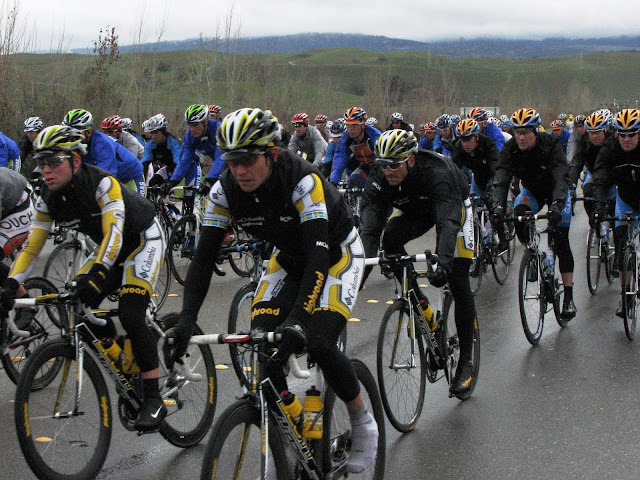
A few minutes later, the peloton came through (Levi had apparently caught up by then but we couldn't really see him) - Ed put his camera on auto-repeat shooting, which means then later you get to try to figure out who exactly you have photos of. You can't really see any of the race numbers because of the angle and all the rain jackets, so resorting to face recognition (and other characteristics such as Lance rides a different coloured bike than the rest of his team):

Chris Horner 3rd from left at the front, in black, with Lance Armstrong (yellow and black helmet) just behind:

Lance Armstrong at the far left (and Mark Cavendish further back, 2nd from the right):

Mark Cavendish on the left not looking too happy(#22), and I think George Hincapie 3rd from the left:

Peloton rounding the corner:

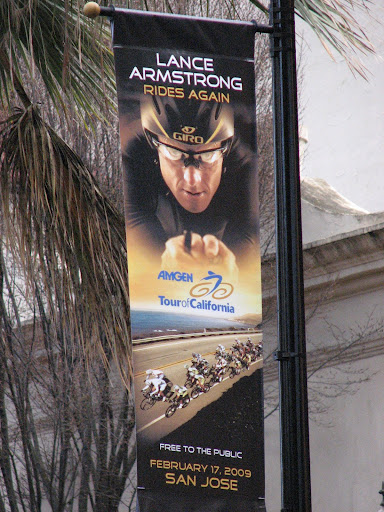
And then it was all over. In case there was any doubt that the publicity for the race was entirely based on Lance Armstrong, here's a photo of one of the banners in downtown San Jose that we saw later that day, as well as one of the billboard on top of Niketown on Union Square in San Francisco.


(at some point, Ed will probably get around to posting all of our vacation pics at the usual smugmug location...)

Saturday, September 6, 2008

Olympics catch-up - miscellaneous articles and stuff.

report from Michael Barry about the mens' RR, where he finished 9th.

NYT reporter rents and rides bikes through Beijing with pro riders Jason McCartney and Michael Barry.

After working hard to help Mick Rogers finish 6th in the Olympic RR, and then coming 5th in the time trial, Cadel Evans revealed that his injury after the Tour de France was actually a ruptured anterior cruciate ligament in his knee. Luckily as cyclists don't need the stability and pivoting ability you'd need for volleyball, skiing, or similar, he won't need surgery. There was then some confusion about his condition, with the Vuelta organizers announcing he was racing in the Vuelta and rumours that he was named to the Silence-Lotto team for the Vuelta - almost seemed as if the communication between Evans' people and his team was lacking somewhat. Now again, he's been named to the long list team for the World Championships - maybe the Australian team managers know that he's recovering well even though all the prior announcements suggested he was out for the season.

And, an interview with Svein Tuft after he came 7th in the Olympic time trial.

(now I can try to keep more up-to-date with posting articles I found interesting).

Monday, July 21, 2008

Canadian Olympian Svein Tuft


Cool biographical article about Tuft
, who rides for the Canadian Symmetrics team ... all his bike touring (with his dog in a trailer behind) in his late teens, even to Alaska and back; and some of his experiences as a pro rider.
“As humans we’ve gotten so far from what we were supposed to do that we’re always searching for something that makes us real again, that gives us that feeling of doing what we’re meant to do. For me, bike racing is that.”

Books and reading about cycling

A few years ago, I read Michael Barry's book "Inside the Postal Bus" and really enjoyed it. IMO, Barry is an excellent writer - instead of just writing about race or training details, or a few humourous anecdotes, he manages to capture the spirit of a race or of cycling in general with his diary entries and columns for his own site and others (Pedal, Velonews, even the New York Times)- he is even poetic at times. And better yet, he's a Canadian - I'm still disappointed he didn't make it to the Tour de France this year (he's still recovering his form after a serious bout of pneumonia last year, so hopefully next year he'll finally get to the Tour), but I'll be cheering for him in the Olympics next month!

Back in May during the Giro, the book "The Giro d'Italia: Coppi versus Bartali at the 1949 Tour of Italy" was highly recommended at Podium Cafe. I found that our library had one copy in the system, so I put a hold on it and picked it up in early June. The author, Buzzati, was an Italian writer who worked as a journalist on the 1949 Giro, writing daily columns about the race at a time when fans either watched along the side of the road, listened on radio, or read the next day's paper for updates on the race. Again, I found the writing to be quite poetic and captured the spirit inherent in the race ... not just basic details, but stories about a lesser racer who goes on a breakaway so that his mamma will be proud when she watches in the finishing stadium, or about those who come in so far after the maximum time that all the trappings of the race have already been taken down, or about the scenes of post-WW2 Italy they were racing through, or about the epic battle won in the end by Coppi. Again, I really enjoyed this book and would recommend it to other cycling fans.
The spectators...do they not perceive in the extraordinary abilities of the two men ... the presence of something mysterious, sacred, a kind of grace, the sign of a supernatural authority? And this may explain the immense attraction of sport. This would justify what otherwise would seem absurd: to wit, that reasonable, well-educated people can lose their heads and get upset and scream over a football player or a cyclist. But there are those who will say: But isn't it frightening that the modern world gives vent to its secret charge of mysticism in the terraces of a stadium? Isn't it humiliating? It is difficult to answer, to be sure. It may be, however, that sports fanaticism, with all its extravagance, is a lot less vulgar than it seems at first glance. (p 60)
Does something as crazy and preposterous as the Giro d'Italia by bicycle serve a purpose, then? Of course it does: it's one of the last meccas of the imagination, a stronghold of romanticism, beseiged by the gloomy forces of progress, and it refuses to surrender. (p 185)

The following seems fitting on this second rest day of the 2008 Tour de France, with 2 mountainous days in the Alps to come starting tomorrow (and with Oscar Pereiro's crash over a guardrail down to the road below fresh in their minds still):
Tonight, those peaks, arrogant and threatening, loom over the sleeping racers: visions of horrendous precipices, roads that make the blood run cold, without guardrails, and carved out of solid rock; and a monster follows them as they struggle up the slopes above the abyss, and salvation is up at the top, where there is a passage between the cliffs, where one never arrives. (p 105)


And then there's the Tour. I've just started reading "The Tour de France: A Cultural History" by Christopher S. Thompson, which so far seems quite interesting - since being at the Tour last year I've been somewhat fascinated by how much of a cultural event the Tour is rather than just a sporting one. Particularly when there are positive doping tests coming out and unknowing North American journalists seem to think that the Tour should just be shut down - that's never going to happen because it isn't just about the race, it's so much more than that. Which is essentially what I wrote last year in this article once I came back from France. I'll post more about this book once I've read more than the first chapter ;-).

Saturday, July 5, 2008

Tour de France Art

I posted at Podium Cafe about 2 recent art exhibits that we went to see, featuring paintings depicting the 2005 Tour de France. Here are a few photos: us with one of the paintings at the AGA, the photo on Toti's business card, a photo from the original AGA description of the exhibit, and the newspaper clipping of yesterday's article.


Another year, another Tour de France

but we're not there in France this year :-(. Which is too bad, because my favourite rider is one of the favourites to win this year (Cadel Evans), and there's a Canadian in the race for the first time in over 10 years (Ryder Hesjedal of the Garmin-Chipotle team).

As for my own riding, I had major unexpected surgery in March, and really I'm only just now starting to get back on track regarding cycling - no way I'd be riding up Alpe d'Huez anytime soon.

So, instead, I'm always finding articles and bits about cycling and my favourite riders that I want to share, sometimes I do that on various internet cycling forums - but I thought perhaps I'd share various links here as well. We'll see how long I actually keep this up ...

Saturday, November 24, 2007

North American Cyclo-crossers in Europe

Since last season, I've been particularly interested to follow the experiences of various North Americans racing cyclo-cross in Europe. I think initially it was that a Belgian friend pointed out how American Jonathan Page was living and training in Europe (rather than racing in the US and only coming to Europe for the World Championships and maybe 1-2 World Cups just prior) that got me intrigued - then I saw some local TV clips and internet articles where I found out that there were some local racers going to Worlds last January and I started reading several of their blogs (thanks Shaun and Spencer).

So, I was concerned to read various articles about Jonathan Page's difficulties this year - he won a silver medal at Worlds after coming back from injury and got signed to a Belgian team, but seemed to be having some disagreements with his team recently. It appeared to culminate with the team claiming he couldn't handle the pressure (and they even sent a doctor to check up on him when he said he was ill and couldn't race), whereas Page claimed team management was putting inappropriate pressure on him and other riders which adversely affected his performance. More recently, they seem to have (temporarily) resolved their differences, in part by shortening his contract to the end of this season (rather than including next season as well).

I've been impressed reading about another American, Jonathan Baker, who is also living in Belgium this season to race cyclocross - I'd noticed his name in some of the results and wondered who this other American in Europe was (the other top American 'cross racers are mostly racing in the US at this point and will only go to Europe after Christmas if at all). An interview at Velonews with Baker showed that he has a admirable attitude, taking a leave of absence from his job as a software engineer and taking his wife and 2 kids with him:
I just wanted to see where I stack up if I give it 100 percent. If that is 40th, whatever. But I think I could get in the top 30 at a World Cup. I'd be pretty happy with that. And obviously I wouldn't be doing it if I weren't having fun. I'm not looking to make a job out of it. But at the same time I'm not just here on vacation. I take it very seriously.
He's also written a diary-style update for Velonews.

And it sounds like several locals are again planning to race in Europe in December-January including Worlds - I'll be reading the results on the internet and probably watching Worlds again on cycling.tv like I did last year (if I manage to get up early enough - so far I haven't managed that for the World Cup races).

FAQ - Tour de France finish line on Champs Elysees

My husband and I had a bit of disagreement before and during our trip - we knew that the Tour finishes on a circuit course on the Champs Elysees in Paris, but weren't sure where exactly the finish line was located. Ed recalled seeing previous podium shots on TV with the Arc de Triomphe in the background and took that to mean that it was located quite close to the Arc, but I wasn't so sure. I'd tried to find more information about the finish on the internet, but couldn't find any sort of map (the official TdF website only had the overall stage map, not anything specific about the finish).

So, on the final Sunday morning of the Tour in July this year, we were up early to scout out where everything was. In the two previous days we could see where they were setting up VIP seating (usually photos of the Obelisk don't include grandstands!) Our hotel was fairly close to the Arc, and we took some photos with our bikes on the Champs Elysees in the closed section between the race course turnaround and the traffic circle at the Arc itself. We'd wanted to try to ride on the course, but couldn't find anywhere to get onto the course as it was very well barricaded - it seemed if you could get on the course, the police didn't really care if you were riding (this was at 9am, long before the caravan or the racers would be coming along) ... but there was really no opening we could see to get onto the actual course.


So, instead we rode along the sidewalk of the Champs until we got close to the park areas where all the VIP seating started and access became a lot more limited. As it turned out, the finish line was where all the grandstands were (and therefore, where the general public without grandstand tickets couldn't get to or see all that well). The closest non-grandstand places to the finish line were already crowded by early in the morning. We took our bikes back to the hotel, and came back to a spot near the intermediate sprint line (right against the barriers) by about 11 am and waited.

That day's L'Equipe newspaper was the most helpful in terms of the actual course route for the circuit finish, so I kept the map and scanned it just in case it can be helpful to anyone else.

Wednesday, October 31, 2007

Canadian team to the Tour de France?

Probably not for a few more years, but this article in the
Province details how the BC-based Symmetrics cycling team is aiming for the Tour within five years.
"No, we're not ready yet," said Cunningham, who thinks it could be done within five years. "We still have a ways to go, not only from an infrastructure perspective and a sponsorship perspective, but we need the cash. We need more team management and we need to add a few riders. There are other strong Canadian riders and we've talked to them, but it comes down to budget."
Symmetrics started with a $30,000 budget. Last year that budget grew to $800,000 and next year it will be $1 million. By comparison, top teams have budgets in the $15-million range.
Cunningham thinks it would take an annual budge of $5 million to $7 million to get a team into the Tour de France.
He said potential sponsors are intrigued by the idea of an all-Canadian team in the Tour, even though doping scandals have plagued the event in recent years.
"The doping issue is a major issue," Cunningham said. "When you walk into a boardroom full of executives, the first thing they start to talk about is Floyd Landis.
"But we have a very clear mandate. We're truly anti-drug. Kevin and I made an agreement amongst ourselves that if there's any hint of doping, we'd shut the team down and give all the money back to the sponsors. We'd shut it down, and the riders know that."


If they manage this, then it would be a big step from the last few years that I've been following pro cycling, in which there have been no Canadian riders in the Tour de France - we were really hoping to see Mike Barry (T-Mobile) there this summer, but then he came down with pneumonia a month or so before.

Thursday, October 11, 2007

A new type of "Bike Race Adventure"

On Sunday, Ed and I plus our friend Alan went to Argyll Park (by the Velodrome) to watch the GP Jim Horner cyclocross races. For the first time, the race had a UCI C2-level ranking (meaning that the results even get posted on Cyclingnews.com).

We arrived during a warmup session, so we explored along the course looking for good vantage points. We chatted with some friendly course marshals right before the first downhill stretch - thanks for your tips! We checked out the longest downhill, with a tricky corner at the bottom (had to make sure you took the right line or you'd get stuck in loose dirt and not be able to turn properly). We also checked out the following uphill, with some logs across the path as barriers - one rider bunny-hopped and rode up the hill in the warm-up, but we didn't see anyone try that during the race, instead it was an opportunity to see how smoothly the best riders get off their bikes, pick them up and run, all in one motion (and same smoothness usually to get back on again at the top - it looked painful when the bike mounting part didn't work so well).

We decided to watch the racing from the bottom of that tricky downhill - first would be the elite women followed a few minutes later by the junior men. Except the women came sooner than we expected (it was only 1 pm by my watch and that was the race start time) so no pics until the junior men came around. Everyone slowed considerably at that corner.

After a few laps we moved along to watch the uphill section. It quickly became clear that Wendy Simms was going to win the women's race unless something drastic happened, and that David Larson would win the junior men's race - in the end, I think he even passed all the women.

We went up to the start area for the callup and start of the elite men's race - racers from Edmonton, Calgary, Saskatchewan, and BC I think. (of course, the Cycling News report mentioned that Tim Heemskerk is from the Netherlands as though he'd travelled here for the race, though I understand he lives here). I recognized some of the names (and faces) from having read various local racers' blogs in the last year since I decided that maybe I should pay attention to (and try to support) local racing not just international stuff ;-) .

Next we watched at the end of the paved section before a corner and a downhill - Alan was impressed at how fast they went by. We also watched them run up the stairs before returning to our favourite downhill and uphill sections, then returned to the start area in time to see the finish. After the first lap, Tim Heemskerk took the lead and didn't relinquish it.


Our photos for the day are here.

It was good to see a mention in the local paper about the weekends' races (even with photos from the following day's Oktobercross race), though it never makes the sports section it seems - this time one of the city columnists mentioned it, and a few times there has been mention of local cyclists in the Outdoors section.
Cyclo-crossers pedal fast to extend racing season
Mountain bikers take on road racers in European cross-country hybrid competition that tests stamina, flying ability
Nick Lees, The Edmonton Journal Published: Wednesday, October 10
Snow, rain, high winds, cloying mud, "bring it on," say hardy cycling devotees who want to extend the racing season. There were more than 200 entries on the weekend for two local cyclo-cross races that saw mountain bikers go head to head with road racers.

"Cyclo-cross racing is growing rapidly," says Daisy Blue Groff, whose United Cycle store organized Monday's Mammoet Oktoberfest race at Goldstick Park. "Competitors are cyclists in denial about winter closing in. They want to extend the racing season."
The origins of cyclo-cross are uncertain, but some say the sport began in Europe in the early 1900s when road racers competed with one another in races to the next town. They were allowed to cut through farmers' fields, jump fences, pedal through forests and run over hills. The sport is strongest in countries such as The Netherlands, Belgium and the Czech Republic. Temperatures force an end to the Alberta season in mid-November," says Groff. "But races in Europe are run through January."

No one was surprised when Dutch-born coach-athlete Tim Heemskerk scored a double victory on the weekend. After winning Sunday's Union Cycliste International race, named for a late Juventus-club founder, Jim Horner, Heemskerk on Monday won the Mammoet Oktoberfest. "Races are usually laps on a 21/2-to-31/2-kilometre route, making them very spectator friendly," says Edmonton's Heemskerk, a former Dutch national mountain bike champion, who in August with his partner Roddi Lega, won the international Panorama-to-Fernie TransRockies Challenge. "Young racers have improved incredibly during the last five years. Some qualified for the world championships last season. I can see Edmonton having a world champion in the next few years."

Cyclo-cross bikes are hybrids featuring traits of both racing bikes and mountain bikes. They are lightweight with drop handlebars, but they use narrow, knobbly tires and old-style, more mud-proof cantilever brakes. Obstacles, such as steps, barriers and hills force riders to dismount and run.

Heemskerk wrote to Mammoet in the Netherlands to ask if they were interested in helping sponsor Monday's race. "I was referred back to Edmonton because this is where their North American headquarters are," he says. "They have clients in the oilsands plants."
Awards went deep when Mammoet donated $3,500 in prize money.

"Cyclo-cross bikes cost in the $1,500 to $2,500 range," says Groff. "Bike companies have seen the interest in the sport grow and are making advances in designs and materials." She added: "People who turned out to watch the races for the first time on the weekend said they were really cool. I'm sure some will be back with their bikes."

Saturday, September 8, 2007

FAQ - Eurostar and Bikes (and other trains)

One of our concerns for our trip in July was whether we would be able to carry our hard bike cases onto the Eurostar train (between London and Lille). In reviewing the Eurostar website, there was some conflicting information - because while on the one hand it mentioned that you didn't need to check baggage, just carry it onto the train - yet on the other hand, it mentioned that "you *should* use our registered baggage service" if you were travelling with bicycles or had too much/too heavy luggage. We wanted no part of the registered baggage service, because we were going to be taking a connecting train from Lille to Arras, so having our bikes arrive in Lille within 24 hours wasn't really helpful if we were already in Arras.

The Eurostar help pages listed that "A bicycle can be carried on Eurostar provided it can be folded or dismantled to fit into a bicycle bag. It can then be carried as part of a passenger's baggage and stowed in an appropriate area in the carriage where passengers are seated." So, this was a bit more helpful - it seemed to suggest that as long as your bike was dismantled and you could carry it on yourself it wouldn't be a problem. But, we weren't sure if they were going to differentiate between a soft bike bag and our hard bike cases.

We also saw this on the help pages: "Your luggage must be no more than two metres in length. Although there is no weight limit, you must be able to lift it into the storage racks provided". So, again we figured we were good, as our cases were just under 2m high and we were able to carry them ourselves.

Yet, on the other hand, when I tried to search on the web for other people's experiences, most of what I found was people using the registered baggage service. So, I even called Eurostar to check, and was told that as long as the bike was dismantled and in a case/bag we could carry it on.

I was a bit nervous checking in at Waterloo station, hoping that we wouldn't be told arbitrarily that our cases were too large and had to be checked in. Other than them not fitting into the x-ray machine of the lineup we were in and having to move over a few lines, we had no problems checking in or going through security. We made sure though to be near the gate entrance right at the time that boarding was due to start, so that we could be among the first to load our cases into the baggage section on our carriage - they stuck out at least 6-8 inches into the aisle, but no Eurostar employees seemed to care in the slightest.

We developed a routine of getting the cases on and off the trains - Ed would take his on board, then I'd hand mine up to him then get on myself (we had our luggage in backpacks/travel packs which made life a lot easier, to have our hands free for the bike cases). Getting off, basically Ed would hand everything off to me on the platform, including the backpacks, and then we'd get organized on the platform rather than trying to put on our packs on the train and manoeuvre the cases off the train while wearing the packs. This worked for the Eurostar, the regional TER train from Lille to Arras, and a few days later the TGV from Arras to Paris - Gare du Nord.

Once in Lille, we had to leave the Lille-Europe station and walk across a bridge to the Lille-Flandres station, where we waited for the regional TER train to Arras. Our excitement for that part of the trip was the lady who vomited in the station, and then later relieved herself in our train car ... most passengers then vacated that car, particularly when the urine puddle made its way down the car. We didn't want to move our cases, but the conductor finally convinced us that our cases would be safe unattended and that we could sit further down in the next car.

A few days later, taking the TGV from Arras to Paris, there was already a lot of baggage in the designated area - but there was an empty table and bench seat across so we stacked our cases there. Again, no train employee seemed to care where they were.

As a side note, we had taken our cases on the Underground from Heathrow Airport to Earls Court Station then walked to our hotel, pushing/pulling the cases. Our hotel was probably a bit closer to the next station (Gloucester Road) but it wasn't fully accessible. Even with wheelchair accessible stations (ie. no stairs which would have been nearly impossible with the cases), there were still long corridors to pull/push the cases and it was a tiring ordeal. So, we got our concierge to book us a van to Waterloo Station when we left and it was quite reasonable. At Paris- Gare du Nord, the taxi line was way too long (and we probably would have needed 2 taxis unless we were lucky enough that a minivan showed up when it was our turn), so we hired a "limo" van - expensive, but worth avoiding the hassle of hauling the cases through the Paris Metro system (and our closest station wasn't accessible anyway). We were lucky when we eventually got back to Paris that an Australian we met on our bus tour had a rental van and drove us to our next hotel. Then we took the Air France shuttle bus, which was quite convenient from our hotel, to the airport when we finally left France.

Anyway, maybe detailing our experiences here will help someone else in future, because I couldn't find a lot of information online about bikes in cases and trains before we went. (I should add - we did all our train travel at off-peak hours, generally between 10 am and 3 pm, so that probably made things easier as well).

Thursday, August 23, 2007

Published!

So, my article about some of our Tour experiences is now online at the Daily Peloton. I wanted to capture more of the atmosphere and the cultural significance of the event, as at this point a simple accounting of who won which stage is a bit irrelevant because I'm sure all cycling fans have already read many accounts of the actual racing.
"This was when I really realized that the Tour de France is bigger than just the cycling race itself, bigger than any doping scandals can destroy, and bigger than any battles between the ASO and the UCI can compromise. I got the sense that the majority of those French families would have been there regardless of who exactly was racing. And in the end, while the race itself was exciting and it was spectacular to see it live, particularly in some amazingly scenic places, I think the majority of my memories are more about the atmosphere surrounding the Tour de France and the people I encountered along the way.

These are things that aren’t dependent on race details such as start lists, who won, or how many positive doping tests occurred. But still, I hope that current anti-doping efforts will help to clean up the sport and that the ASO and UCI can sort out their differences for the betterment of cycling world-wide, so that the Tour de France can remain a prominent sporting event as well as a social and cultural one."


I also thought it was important to point out to friends and family in North America that the many media accounts suggesting the imminent demise of the Tour because of doping scandals are a little bit exaggerated... this was a point also made by Alex Stieda in talking to a columnist at the Edmonton Journal recently.
Stieda, whose cycling career began with a paper route, says North Americans often don't realize European cycling stars, who cover about 4,000 kilometres on the 22-day, 20-stage tour, are as well- known as hockey stars are here.


So, one could say that the Tour de France ending because of doping scandals is just as likely to happen as the NHL folding because of a season-long lockout ... and obviously the NHL is still alive and well.

Sunday, August 19, 2007

FAQ - Cycling from Arras to Vimy (Canadian Memorial)

As mentioned before, I have plans to put up some information about useful items we would have liked to know beforehand, but couldn't really find anywhere (or at least, couldn't find the information simply or concisely or consistently). So, this is the first of these.

As we could read on the official website and in guidebooks, the Canadian National Vimy Memorial is about 10 km north of the town of Arras, where we stayed for a few days in July. However, almost all the instructions we encountered (and that official distance) are for driving there, not for riding a bike - and we had no intention of riding on the N17 motorway (or worse yet, on the Autoroute) to get there.

Before leaving home, I purchased the Michelin #301 "Pas-de-Calais, Somme" Local map from a specialized map store - so we knew that there were other local "D" roads available to get to the memorial. (Helpful Hint - unless you're a true map fanatic and need to see the map well ahead of time, wait and buy it there in a bookstore - much cheaper at 4 Euros rather than the $14.95 Cdn I paid! You can always look at Via Michelin beforehand to get a sense of the area, and even print out a map from a specific search). The scale of the local Michelin map, 1/150000 was too large to get an idea though of how to get out of Arras to get on to any of these "D" roads - and the inset of Arras at larger scale was only a bit more helpful as it really only included the centre-ville area.

So, once in Arras, we went to the local tourist office located in the Town Hall. While we did get another local map of the centre of town, the workers there couldn't really help us with planning a bike route to Vimy - their best advice was "you don't want to go on the Motorway" and when we pointed to some of the smaller roads on our map they agreed but didn't give us any assistance as to how to get to those roads or which might be the best choice.

Therefore, we set off by walking our bikes over the cobbles of the Grand'Place north of our hotel, then rode west on the Rue Méaulens to the roundabout at the Place de Tchecoslovaquie. From there, we rode along the Rue Michelet to the north-east - but our larger-scale maps pretty much ended at that point.

On the local Michelin map, we knew that we wanted to turn north and head towards Roclincourt, but unfortunately the map didn't give any sort of name or number for this road. There were directional signs to various places, but mostly for things like the church (L'église) or the town hall (La Mairie) or how to get to the Motorway, and didn't help us much. So, we ended up going probably 3 km out of our way to the east, ending up at St. Laurent-Blangy, before we saw a bus stop with a map where I was able to determine that we did in fact want to turn north at the sign for the St. Nicholas Mairie.

We were a little bit concerned as we approached the motorway that we were in fact going to go over it rather than end up on it (as it was a bit of a detour rather than straight across), but once on the other side and heading north again we were reassured by signs that pointed towards Roclincourt (the next village we were aiming for on the map).

All was well until we got to Thélus, where once again the lack of a specific larger-scale local map was a problem - we got a good exploration of Thélus in several directions, including east to the N17 motorway and out northwest to a dead-end before we took what looked like a relatively main road northward that was labelled to the cemetery. This did take us north-west like we wanted, ending up at the N17 with the apparent road into the memorial a bit south on the opposite side of the N17. (and looking back at Google Earth/Google Maps afterwards, we somehow missed the "Rue de Vimy" which was what we wanted - I think we were on the Rue des Abouts and Rue de 19 Mars instead, before ending up on the Rue de Vimy).

Unfortunately, this road was blocked off to traffic, with instructions (in French) about how to detour around back to all the major roads we were trying to avoid in order to get to the Memorial from the opposite direction. It was slightly concerning that in English the sign only mentioned road construction, but in French it mentioned work being done for undetonated explosives and how dangerous it would be to go this way. On the other hand, it would also be quite dangerous to ride in busy traffic on the motorway! There was a mountain biker who had lifted his bike over the barrier and rode in just before we got there, and as he didn't come back (and we didn't hear any loud explosions), we decided to go this route we'd planned. There was only one area where there was some construction being done a bit off the road, and the workers waved to us as we rode by - lol. So much for my anxieties about being chased away by security or something like that.

The bonus was that at the end, we had a lovely tree-lined boulevard all to ourselves with no cars allowed (see photos below). We were happy to see the official Canadian government sign signifying we'd reached the official Memorial area, near the trenches/tunnels area of the Memorial site. We were able to ride our bikes up to the main memorial area, where we locked them to a pole in the parking lot. (We think that the security guard offered to watch them for us such that we didn't need to lock them, but we weren't secure enough with our French to be sure so we locked up anyway). Back near the trenches/tunnels area (where the official Visitor Centre is), we were able to lock up again at an actual bike rack in the parking lot.


On the way back to Arras, this time instead we went south to Neuville-St. Vaast, east along the D49 to Thélus (probably how we should have gone from Thélus had we known the other road would be closed), then back south through Roclincourt to Arras and kind of randomly along a few one-way streets to our hotel (tackling the cobbles this time rather than walking - ouch ;-) ).

Total time: going = 1.5 hours, 21.3 km; coming back = 45 minutes, 15.4 km.
Route summary:
-from Arras Grand'Place, NW on Rue Méaulens, then NE on Rue Michelet/D41, then N on Rue Raoul Briquet (according to Google Maps, just where Rue Michelet turns into Rue Anatole France).
-turn left when you get to the N17, go across it, then right again and N on Route de Roclincourt/Rue d'Arras.
-once at Thélus, probably best to go left/W on the Grande Rue/D49 to Neuville-St.Vaast to avoid the potentially-still-closed road we took.
-from Neuville-St. Vaast, go north on the D55/Route du Canada (is that obvious or what?) and there were even signs from this direction directing you to the Canadian Memorial, so should have no problems finding it from here.

(I tried to plot our routes on images I saved from Google Earth, seeing as our Garmin Edge didn't seem to work that day to plot it automatically for us - sorry for the wobbles).

Thursday, August 16, 2007

Our photos (finally)

Our photos are posted online at smugmug, and I think we've done the majority of the captions that we plan to. So, enjoy.

I have also written an article about some of my observations at the Tour that should be posted on this cycling website shortly (and another to follow about "Tips for going to the Tour", when I finish writing it that is).

Monday, August 6, 2007

Song Mystery Solved

So, one day while we're on the bus going back to the hotel after a Tour de France stage, there's a song played on our bus that seemed to be some sort of Tour song (as in, it mentioned "De Londres a Paris" and a number of the stage start/finish towns, also we could pick out words such as "peloton" but being that it was in French, couldn't catch all the lyrics). Then, on several subsequent stages I heard the same song being played from the caravan as it went by. So, when we got home, I was trying to Google to find out what this song might be, without any real luck.

When we went through some of our freebies from the caravan, I noticed the CD from Bouyges Telecom that I'd mostly ignored previously, figuring that it was some sort of promotional video or similar. Except, now I noticed that some of the words on the cover matched some lyrics from the "mystery song" - and I remembered that when I'd heard the song from the caravan it was in fact from the Bouyges vehicles. So, into the computer went the CD and sure enough, there was the song. Presumably our bus driver or tour guide had picked up a CD at the stage and put it in the CD player on board that day when we first heard it ...

Looking further on the Bouyges website, looks like it is part of some promotional campaign. Not sure of all the lyrics, but some are "I know that you collect" and "everyone everywhere" - so I wonder if it's actually a song about the Tour caravan. In any case, if you want to listen yourself, there are clips here.

Friday, August 3, 2007

Cadel came 2nd!

So, my favourite rider came 2nd overall in the Tour de France - don't have access at the moment to my husband's pics of the final podium, so instead I'll share this one at the top of the Col d'Aubisque (last mountain stage). Michael Rasmussen had attacked near the end of the stage to take a solo victory, only to be fired from his team later that night for lying about his whereabouts when he missed an out-of-competition drug test in June. So, while our podium pics from that day are somewhat meaningless (ie. Rasmussen the stage winner and Rasmussen in the yellow jersey), to me it was interesting to see the run-off area after the finish line - Cadel being whisked away to a media scrum in this photo, then afterwards trying to go back up the hill just a bit and needing to grab onto the team guy with him for assistance, obviously used up everything on the climb. As did teammate Chris Horner - he came in a few minutes later and immediately got off his bike to sit down.

Thursday, August 2, 2007

Home, but not the end of the "Adventures"

Yes, we made it home last night - while stopped over in Toronto we couldn't help thinking that maybe we should have gone back to London as the flying time from London to Edmonton is the same as Paris to Toronto (but then you have another 3-4 hours back from Toronto to Edmonton). Bikes seem fine, more importantly the "Cote du Ventoux" wine is fine ;-).

I'm not finished with the blog entries, though - I do plan to put up more details and some photos, as well as some FAQ-type stuff that I had a hard time finding before our trip (like "Eurostar and bikes", or "How to ride from Arras to Vimy Ridge and not get lost", or "Where exactly does the Tour finishing circuit go on the Champs Elysees?", or "How we packed our bikes so that they survived Air Canada"). So stay tuned.

In the meantime, it seemed that quite a number of our random peloton shots included Tom Boonen (or maybe he was just easier to pick out as leader of the green jersey competition, perhaps there's another rider we photographed just as much but haven't recognized yet). So, here's one of those shots (which includes the then-yellow-jersey wearer Fabian Cancellara as well):

Monday, July 30, 2007

Tour finale

Spent the day yesterday on the Champs Elysées for the Tour de France finale - couldn't get myself up early enough to be able to ride our bikes on the actual course but we got some pics on our bikes with the Arc de Triomphe in the background (without getting run down by traffic) and rode along the course on the sidewalk to get the layout. Already by 9 am the public viewing sites closest to the finish were gone (the best areas seemed to be where the grandstands were, including to see the podium from the front). We put our bikes back in the hotel, then staked out a spot just past the sprint line to watch the race - right at the barriers at 11am but it was 8-10 people deep there behind us by the time the caravan and race came around.

Really neat to see them come around 8 times (= 16 viewings) rather than the usual once. And I saw Cadel Evans on the podium (he came 2nd overall) even if from 100 m behind the podium. The team parade afterwards was neat too - lots of flags and rider antics (wheelies, Julian Dean in a top hat, etc.)

Mixed emotions - excitement of having seen the Tour, but disappointment at all the doping scandals.

Wednesday, July 25, 2007

Finally, a mountaintop finish!

Don't have much time but just wanted to say that we did a 30 km climb today up to the top of the Col d'Aubisque to watch the stage finish, and it was really cool. 90 km round-trip ride. will type more in Paris.